Microsoft uses the MBR (Master Boot Record or partition table) to store the exact location of your operating system files. When you turn on your computer, your system looks up this crucial record to start Windows. Because hard drives and SSDs are complex hardware, the MBR can occasionally get corrupted, or you may face the dreaded “BOOTMGR is missing” screen. If your MBR gets damaged, Windows won’t boot. When that happens, here is how to fix your MBR and get Windows booting normally again.
There are a number of reasons why the MBR might get corrupted: sudden power outages, malware or boot-sector viruses, failed updates, or misconfigured disk settings. When that happens, your computer may get stuck in a boot loop or display errors like “BOOTMGR is missing. Press Ctrl+Alt+Del to restart.” If you have run into this issue, repairing your Master Boot Record will get your Windows installation back up and running.
Follow this step-by-step guide and you will see that fixing an MBR issue is much easier than taking your PC to a computer repair shop. These steps work seamlessly on Windows 10, Windows 11, Windows 8.1, and Windows 7.
Fixing an External Hard Drive? If your internal Windows system boots fine but an external USB drive or external SSD is showing as RAW or unreadable, check out our companion guide: How to Fix MBR on External Hard Drive.
Step 1: Boot into Windows Recovery Command Prompt
Because Windows won’t boot into the desktop, you will need a Windows bootable USB or installation media to reach the recovery Command Prompt.
- Visit Microsoft’s website and download the Windows 10 ISO file (or download Windows 11 if that is what your PC runs).
- Use Rufus or the Windows Media Creation Tool to burn the ISO onto an empty USB flash drive (at least 8 GB).
- Insert the USB drive into your non-booting computer. Power it on and immediately press your motherboard’s boot menu key (usually F12, F11, F9, ESC, or Del) or enter the BIOS/UEFI settings to select USB boot.
- On the initial Windows Setup screen, pick your language and keyboard preferences, then click Next.
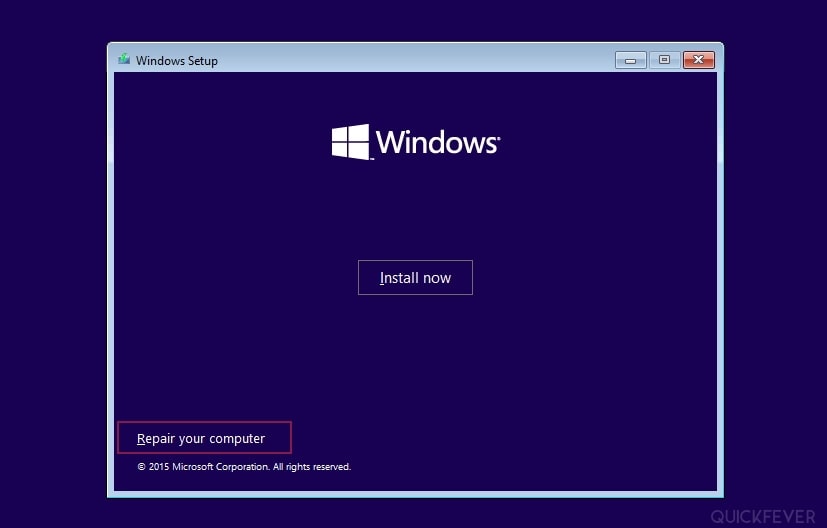
- Do not click “Install now.” Instead, click Repair your computer in the bottom-left corner (or press the R key on your keyboard).
- On the blue screen that appears, click on Troubleshoot.
- Under Troubleshoot, select Advanced options.
- Click on Command Prompt.

The command prompt window will open (typically pointing to X:\Sources> or X:\Windows\System32>). From here, you can execute the built-in Bootrec.exe tool to rebuild and repair the Master Boot Record and boot configuration data.
Step 2: Use Bootrec Commands to Repair MBR
The bootrec.exe utility supports several key switches designed to repair corrupted boot files. Run the following commands in order:
1. Bootrec /FixMbr
Bootrec /FixMbr writes a new Windows-compatible Master Boot Record to the system partition. This resolves corrupt MBR code without altering or overwriting your existing disk partitions and files.
bootrec /fixmbrPress Enter. You should see a confirmation saying “The operation completed successfully.”
2. Bootrec /FixBoot
Bootrec /FixBoot writes a fresh boot sector to the system partition. Boot sector records can become overwritten or misconfigured, especially if you set up a dual-boot configuration with an older Windows version or Linux distribution.
bootrec /fixbootTroubleshooting “Access is denied” on Bootrec /FixBoot:
On modern Windows 10 and Windows 11 UEFI systems, running bootrec /fixboot may return an “Access is denied” error. If you see this, assign a drive letter to your hidden EFI System Partition and repair it directly using these quick commands:diskpartlist volumeselect volume X (replace X with the small FAT32 volume, usually 100MB to 260MB labeled System or EFI)assign letter=S:exitbcdboot C:\Windows /l en-us /s S: /f ALL
Once completed, your boot files are rebuilt cleanly!
3. Bootrec /ScanOS
This command scans all connected storage drives for Windows installations that are not currently included in the Boot Configuration Data (BCD) store.
bootrec /scanosIf it finds installations, it displays the total identified Windows systems.
4. Bootrec /RebuildBcd
This command scans for installed operating systems and lets you rebuild the BCD store from scratch so your computer knows where to boot.
bootrec /rebuildbcdWhen it finds your Windows installation, it asks: “Add installation to boot list? Yes(Y)/No(N)/All(A):”. Type Y and press Enter.
Fixing the “BOOTMGR is Missing” Error

If your system specifically fails with any of the following error messages, rebuilding the existing BCD directly might fail because the old corrupted BCD file is locked or damaged:
- “BOOTMGR is missing. Press Ctrl+Alt+Del to restart”
- “BOOTMGR is missing. Press any key to restart”
- “BOOTMGR image is corrupt. The system cannot boot.”
- “Couldn’t find BOOTMGR”
In that scenario, export your old BCD, rename the corrupted file, and rebuild a completely fresh BCD store. In the recovery Command Prompt, execute these commands line-by-line, pressing Enter after each:
bcdedit /export C:\BCD_Backup
c:
cd boot
attrib bcd -s -h -r
ren c:\boot\bcd bcd.old
bootrec /rebuildbcd
When prompted to add the Windows installation to the boot list, press Y and hit Enter.
Once finished, type exit or close the Command Prompt window, remove your bootable USB drive, and select Continue (Exit and continue to Windows). Your computer should now boot normally into Windows.
What to Do If MBR Repair Still Fails
Repairing the boot manager is usually quick and straightforward with these built-in recovery commands. However, if your drive has severe partition table damage, extensive physical bad sectors, or hardware failure:
- Run CHKDSK to repair filesystem errors: In the recovery Command Prompt, run
chkdsk C: /f /rto detect and relocate damaged disk sectors. - Perform a fresh Windows installation: Since you already have the bootable Windows USB prepared, you can perform a clean install of Windows. While this reinstalls system files from scratch, you can preserve personal data in the
Windows.oldfolder if you choose not to format the partition during setup.
In most everyday situations, running bootrec /fixmbr, bootrec /fixboot, and bcdboot will get your PC back up and running without any data loss.