How to change DNS server on a Windows 11 PC, and best public DNS servers list.
DNS Servers are used to resolve IP addresses assigned to domain names. You will browse faster and more reliably if you use a fast DNS resolver. This article will help you change the DNS server on your Windows 11 PC, plus explore our companion list of the best free and public DNS servers.
Helpful companion guides: How to Edit Hosts File in Windows 11, 5 Free and Reliable VPNs for Windows 11, and our guide on how to clean install Windows 11.
1. What Is a DNS Server and Why It Matters
DNS servers do their work by resolving a website name to its associated IP address. To make it simple: when you type a website name into your browser’s address bar, the browser sends a query to the DNS server and receives the associated IP address. The browser then connects using that IP address to open the site. Google Public DNS and Cloudflare DNS offer free and reliable public DNS resolvers that you can use for faster lookups and improved privacy.
2. Quick Reference: Best Public DNS Servers for Windows 11
If you just need the exact IP addresses to paste into your network adapter, here are the most trusted, high-performance public DNS providers:
| DNS Provider | Primary IPv4 | Secondary IPv4 | Primary IPv6 | Key Highlights & Encryption |
|---|---|---|---|---|
| Cloudflare | 1.1.1.1 | 1.0.0.1 | 2606:4700:4700::1111 | Fastest overall resolve time, zero logs, full DoH support |
| Google Public DNS | 8.8.8.8 | 8.8.4.4 | 2001:4860:4860::8888 | Massive global infrastructure, reliable uptime, full DoH support |
| Quad9 | 9.9.9.9 | 149.112.112.112 | 2620:fe::fe | Automatic malicious domain blocking, privacy-focused, DoH support |
| AdGuard DNS | 94.140.14.14 | 94.140.15.15 | 2a10:50c0::ad1:ff | Default ad and tracking script blocking across all system apps |
| OpenDNS (Cisco) | 208.67.222.222 | 208.67.220.220 | 2620:119:35::35 | Phishing protection and customizable web filtering |
Looking for gaming-optimized resolvers, family safety filters, or custom blocklists? Explore our full breakdown of the best free and public DNS servers.
3. Check Your Current DNS Server (Before Changing Anything)
Before you jump into your router’s settings and messing things wait, hold on a second.
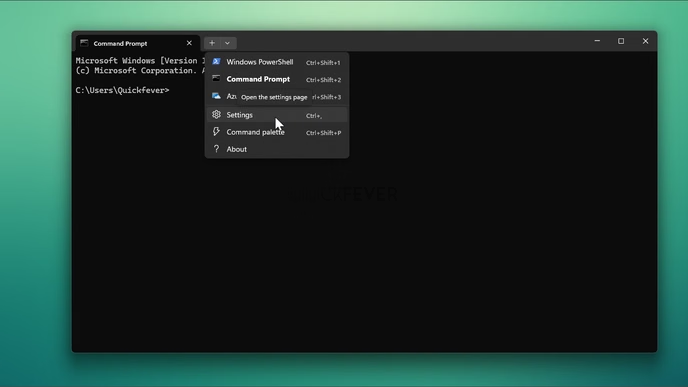
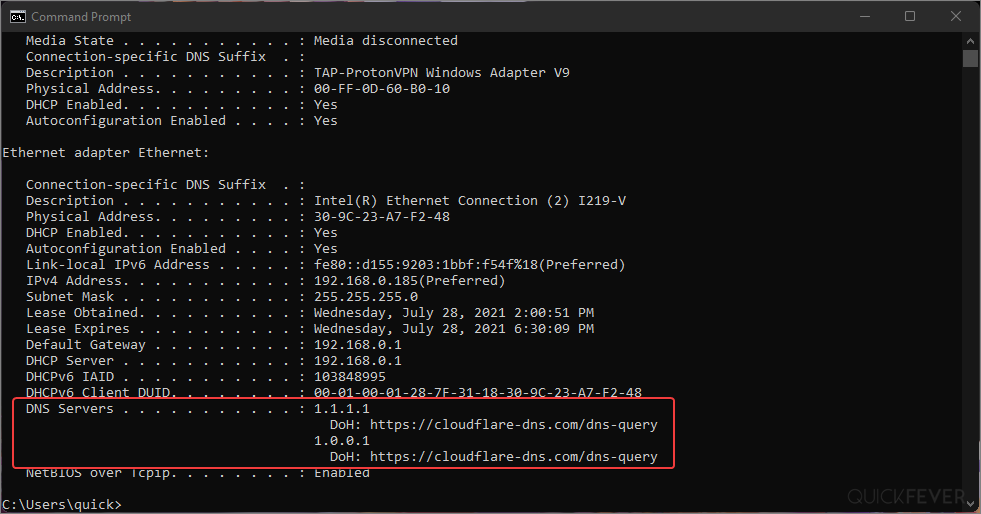
Type ipconfig /all in Command Prompt and it will show your current DNS server. Make a note of this. In the example below, Cloudflare’s 1.1.1.1 shows up as the active DNS server on our computer.
Pro Tip: Command Prompt only shows what your adapter is currently configured with. To verify if your DNS queries are leaking to your ISP, open dnsleaktest.com in your browser and run a standard test to verify your active DNS resolver IP.
4. Choosing a DNS Server: Public & Local Benchmarks
Selecting a DNS server might seem confusing when browsing speed differences are measured in milliseconds. To clear up the confusion, check the public DNS performance report by DNSPerf.com, select your continent, and review the fastest resolvers in your geographical region.
- For Asia: Currently, Cloudflare (1.1.1.1), Google Public DNS, and DNSFilter consistently lead performance tables.
- For North and South America: Cloudflare, Quad9, Cisco Umbrella, and NextDNS offer the lowest latency.
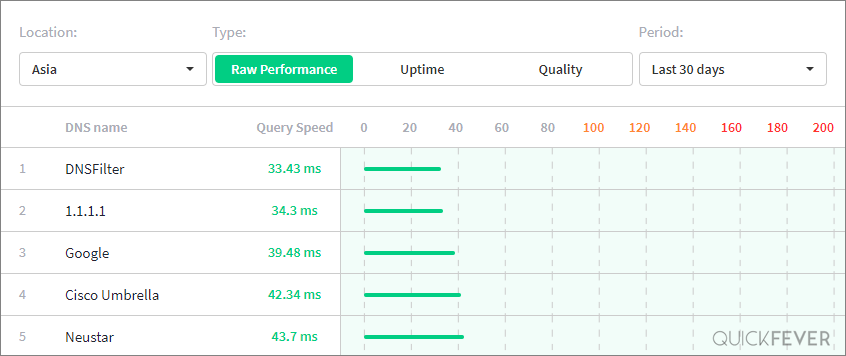
Cloudflare (1.1.1.1) remains our preferred daily choice because of its global routing speed and strict privacy stance. Every public DNS provider supplies two IP addresses: the first is your primary resolver, and the second acts as a fallback IP if the first becomes temporarily unreachable.
Public benchmarks represent regional averages, which might not reflect your specific ISP routing. For example, a public benchmark might list Google’s average response time as 39ms for Asia, while on my local connection it pings at just 10ms. You can measure resolve times directly from your PC using lightweight desktop benchmarking tools:
- DNS Jumper: Portable utility that benchmarks public servers and applies them with one click.
- GRC’s DNS Benchmark: Steve Gibson’s classic utility for in-depth DNS cache benchmarking.
5. Method 1: Change DNS Server in Windows 11 Settings (with DNS over HTTPS)
The modern Windows 11 Settings app is the easiest place to configure custom DNS addresses and enable native DNS over HTTPS (DoH) encryption.
Step 1. Right-click the Network icon on the right side of your taskbar and select Network and Internet settings (or open Settings with Win + I and navigate to Network & internet).

Step 2. Click on Wi-Fi or Ethernet (depending on how you connect), select your network properties, and scroll down to locate DNS server assignment. Click the Edit button.
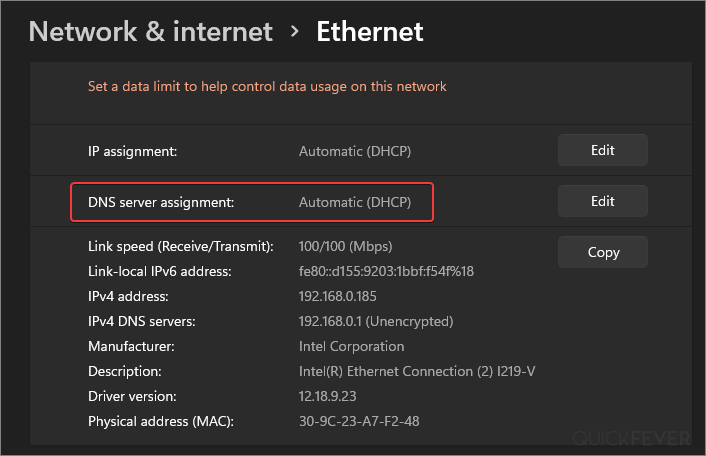
Step 3. In the pop-up dialog, change the dropdown from Automatic (DHCP) to Manual. Toggle the IPv4 switch to On.
Now enter your preferred resolvers in the fields provided:
- Preferred DNS: Enter your primary resolver (for example,
1.1.1.1for Cloudflare or8.8.8.8for Google). - Alternate DNS: Enter your secondary resolver (such as
1.0.0.1or8.8.4.4). - DNS Encryption: Under both Preferred and Alternate DNS encryption dropdowns, select Encrypted only (DNS over HTTPS) or Encrypted preferred. This wraps your DNS requests inside secure HTTPS port 443 tunnels, stopping ISPs and public Wi-Fi operators from logging domain names you query.
You can be creative here: for primary DNS you can enter Cloudflare DNS 1.1.1.1 and in alternative DNS you can enter Google’s DNS server 8.8.8.8. It can be any pair of trusted public resolvers, as long as both servers are functional and responsive.
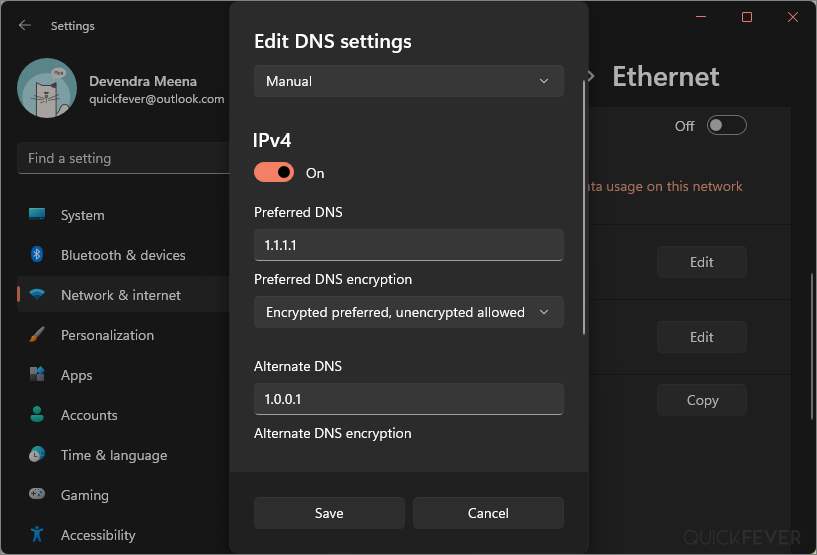
Click Save to apply your new DNS configuration immediately.
6. Method 2: Change DNS Server from Control Panel (ncpa.cpl)
If you prefer the classic Control Panel interface or need to configure specialized static network settings, the traditional Network Connections dialog remains fully supported in Windows 11.
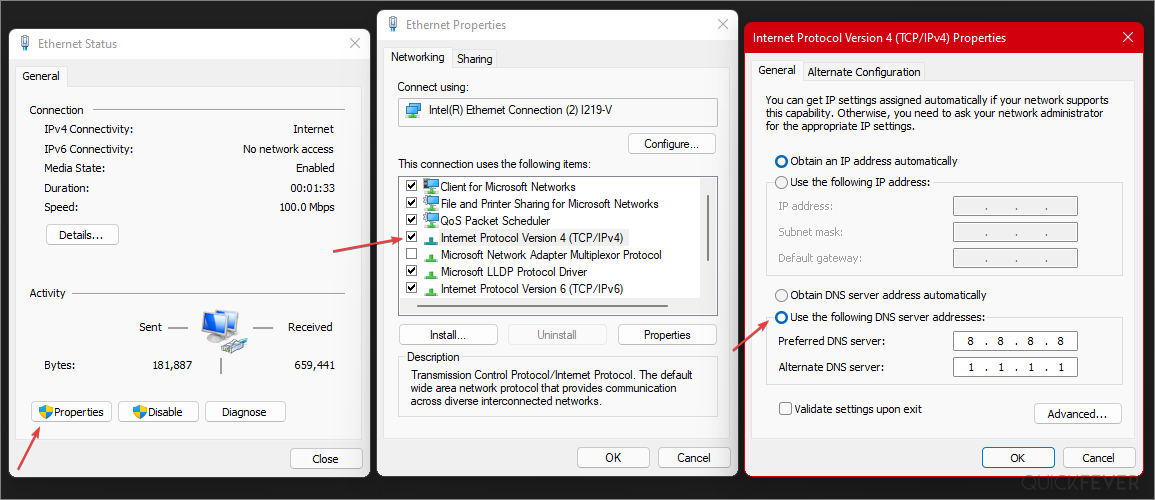
- Press
Win + R, typencpa.cpl, and press Enter to jump directly to Network Connections. - Right-click your active connection (Wi-Fi or Ethernet) and select Properties.
- Scroll down the list, select Internet Protocol Version 4 (TCP/IPv4), and click Properties.
- Select Use the following DNS server addresses.
- Enter your Preferred DNS server (e.g.,
1.1.1.1) and Alternate DNS server (e.g.,1.0.0.1). - Click OK on both dialog boxes to save changes.
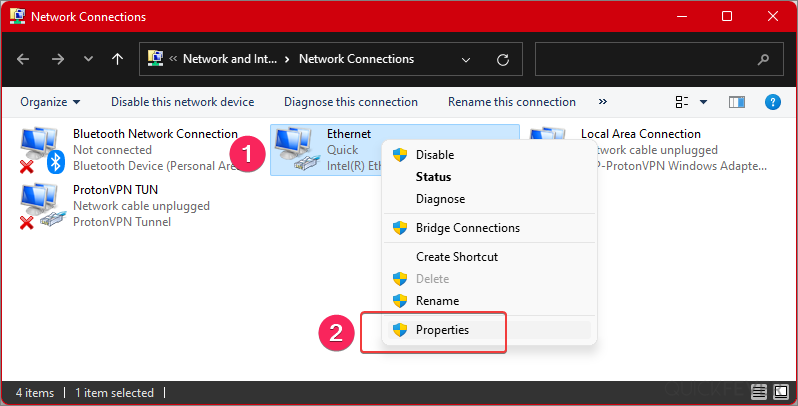
Review the screenshot below to verify the exact TCP/IPv4 properties layout before saving:
7. Method 3: Change DNS Server Using PowerShell (One-Line Command)
For system administrators and command-line fans, PowerShell allows you to switch DNS resolvers across network adapters in seconds.
Step 1. Press Win + X and select Terminal (Admin) or PowerShell (Admin).
Step 2. Run the following command to list your active network adapter names:
Get-NetAdapter | Select-Object Name, InterfaceDescription, Status
Step 3. Assign your chosen DNS servers by running:
Set-DnsClientServerAddress -InterfaceAlias "Wi-Fi" -ServerAddresses ("1.1.1.1","1.0.0.1")
(Replace “Wi-Fi” with “Ethernet” if you are plugged in via network cable.)
If you ever want to revert back to your router’s automatic DHCP server, simply run:
Set-DnsClientServerAddress -InterfaceAlias "Wi-Fi" -ResetServerAddresses
8. Method 4: Benchmark and Apply DNS with DNS Jumper
If you prefer a lightweight portable utility that handles both benchmarking and 1-click switching, DNS Jumper is an excellent companion tool.
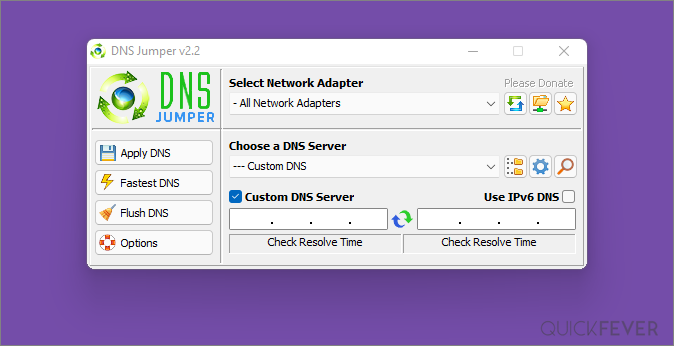
Step 1. Open the DNS Jumper utility. Select a preset provider from the dropdown or tick Custom DNS Server to enter your own IPs.
Step 2. Press the refresh icon between the primary and secondary fields to test resolve times directly from your computer.
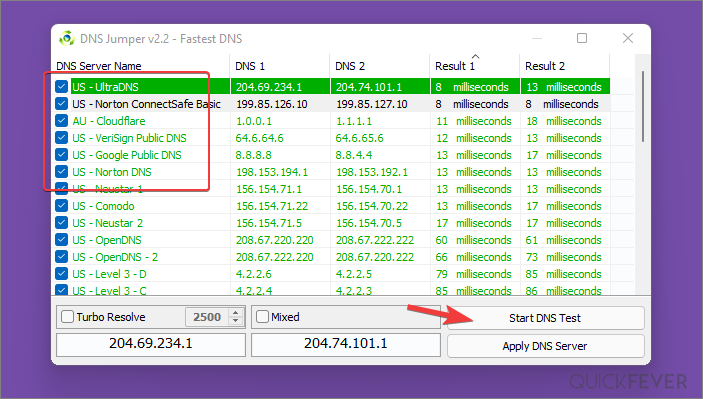
Step 3. Click on Fastest DNS to initiate a full batch test. In a few seconds, the tool sorts public servers from lowest to highest latency. Click Apply DNS on whichever resolver yields 10ms to 40ms response times.
9. How to Flush and Verify Your DNS Cache
Whenever you update your DNS resolver, flush the Windows local resolver cache. This purges stale address records stored from previous sessions so your system immediately routes through the new DNS server.
Open Command Prompt or PowerShell and run:
ipconfig /flushdns
To verify that domain queries resolve properly through your newly selected server, test a live lookup:
nslookup quickfever.com
You can also query a specific server directly to compare response speeds:
nslookup quickfever.com 1.1.1.1
If the command outputs the correct IP address without timing out, your new DNS server is working. Tell us in the comments which DNS provider gave your Windows 11 PC the lowest resolve times.