
DNS Servers are there whether you know about them or not. They resolve domain names into numerical IP addresses so your browser can connect to servers worldwide. While your Internet Service Provider (ISP) automatically assigns you a default DNS server, ISP resolvers are often sluggish, poorly routed, prone to outages, and frequently log or censor your browsing activity. Switching to a fast, secure public DNS server is one of the easiest ways to speed up your web browsing, block phishing threats, eliminate ads, and protect your privacy.
Every DNS server listed in this guide is 100% free to use with public IPv4 and IPv6 addresses, as well as modern encrypted DNS protocols like DNS-over-HTTPS (DoH) and DNS-over-TLS (DoT). One pro-tip I learned over the years: it is often practical to use the secondary IP of any DNS server as the Primary on your computer because standard traffic hits the primary address by default, meaning secondary endpoints can occasionally offer even faster response times.
Why Is Choosing a Better DNS Server Important?
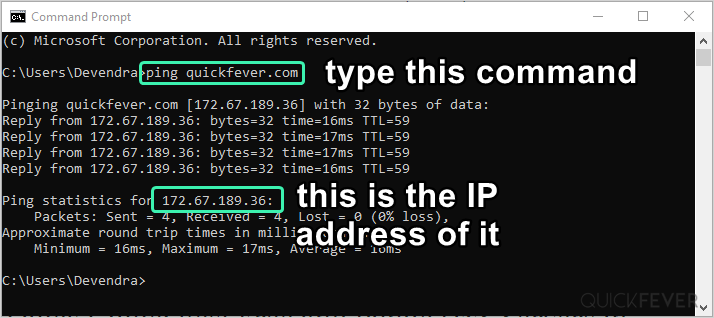
When you type a website URL into your browser, your computer queries a DNS resolver to obtain the IP address assigned to that domain. (You can also find your local and external IP address to see how your own connection is identified). Once the resolver translates the domain name, your browser establishes a connection and loads the page.
Want to see this translation in real time? Open Command Prompt and type ping quickfever.com:
Modern webpages load dozens of assets (scripts, fonts, images, and analytics) hosted across multiple domains. If your ISP’s DNS resolver takes 50 to 100ms on every lookup, those delays compound, making browsing feel sluggish. A faster DNS server will not increase your raw internet download bandwidth, but it substantially reduces the lookup lag before a page begins rendering. For competitive online games (like PUBG, Call of Duty, or Valorant), lower DNS latency also ensures faster server matchmaking and connection stability (read our guide to troubleshoot online gaming ping spikes if latency remains an issue).
Best Free and Public DNS Servers (Complete Comparison)
Here is the updated master list of the most reliable, high-performance public DNS servers available, complete with IPv4, IPv6, and encrypted DNS hostnames:
| Provider | Primary IPv4 | Secondary IPv4 | Primary IPv6 | Best For / Key Feature |
|---|---|---|---|---|
| Cloudflare (1.1.1.1) | 1.1.1.1 | 1.0.0.1 | 2606:4700:4700::1111 | Fastest global response time & zero query logging |
| Google Public DNS | 8.8.8.8 | 8.8.4.4 | 2001:4860:4860::8888 | Maximum uptime & unmatched global stability |
| Quad9 | 9.9.9.9 | 149.112.112.112 | 2620:fe::fe | Security: real-time malware, spyware & phishing blocking |
| AdGuard DNS | 94.140.14.14 | 94.140.15.15 | 2a10:50c0::ad1:ff | System-wide ad, tracker, and malicious pop-up blocking |
| Cisco OpenDNS | 208.67.222.222 | 208.67.220.220 | 2620:119:35::35 | Customizable web filtering & anti-phishing |
| Control D | 76.76.2.0 | 76.76.10.0 | 2606:1a40:: | High-speed modern resolver with custom threat profiles |
| CleanBrowsing | 185.228.168.168 | 185.228.169.168 | 2a0d:2a00:1:: | Family Filter: blocks adult content and enforces SafeSearch |
| NextDNS | Account-assigned IPv4 | Cloud-hosted Pi-hole with personalized ad & security lists | ||
Specialized Public DNS Variants (Family & Malware Blocking)
Several major providers offer specialized IP pairs depending on whether you want unfiltered performance, malware protection, or family-safe browsing. If you want browser-level controls alongside network DNS filtering, you can also block websites in Google Chrome directly.
- Cloudflare for Families:
- Malware Blocking Only: Primary:
1.1.1.2| Secondary:1.0.0.2 - Malware & Adult Content: Primary:
1.1.1.3| Secondary:1.0.0.3 - OpenDNS FamilyShield (Pre-configured adult block): Primary:
208.67.222.123| Secondary:208.67.220.123 - AdGuard Non-Filtering (Raw lookups, no ad-block): Primary:
94.140.14.140| Secondary:94.140.14.141 - CleanBrowsing Adult Filter: Primary:
185.228.168.10| Secondary:185.228.169.11
How to Change DNS Server on Windows 11 (with Encrypted DoH)
Windows 11 natively supports DNS-over-HTTPS (DoH), which encrypts your DNS lookups so no one on your local Wi-Fi or your ISP can see what domains you visit. For a dedicated walkthrough with extra troubleshooting, see our Windows 11 DNS setup guide. Here is how to configure it directly in Windows 11 Settings:
- Press
Windows + Ito open Settings and click on Network & internet. - Click on Wi-Fi or Ethernet (whichever connection you are actively using), then click your network name to open its properties.
- Find DNS server assignment and click Edit.
- Change the dropdown menu from Automatic (DHCP) to Manual, then toggle on IPv4.
- Enter your preferred DNS addresses (for example,
1.1.1.1for Preferred and1.0.0.1for Alternate). - Under Preferred DNS encryption, select Encrypted only (DNS over HTTPS). Do the same for Alternate DNS encryption.
- Click Save. Your DNS queries are now fully encrypted!
Need to block or redirect a specific domain locally? Instead of changing your entire system DNS, you can edit the Windows hosts file to manually map domain names to custom IP addresses on your PC.
How to Change DNS Server on Windows 10 (Control Panel Method)
If you are on Windows 10 or prefer using the classic adapter properties dialog, follow these 5 simple steps:
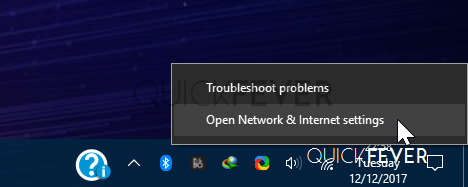
- Right-click on the network icon in your taskbar tray and select Open Network & Internet settings.
- Click on Change adapter options (or press
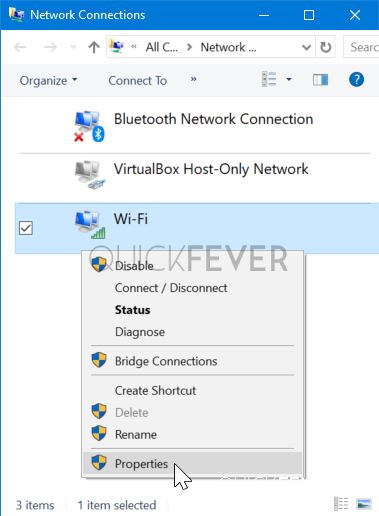
Windows + R, typencpa.cpl, and press Enter to jump straight there). - Right-click your active connection (Wi-Fi or Local Area Connection) and select Properties.
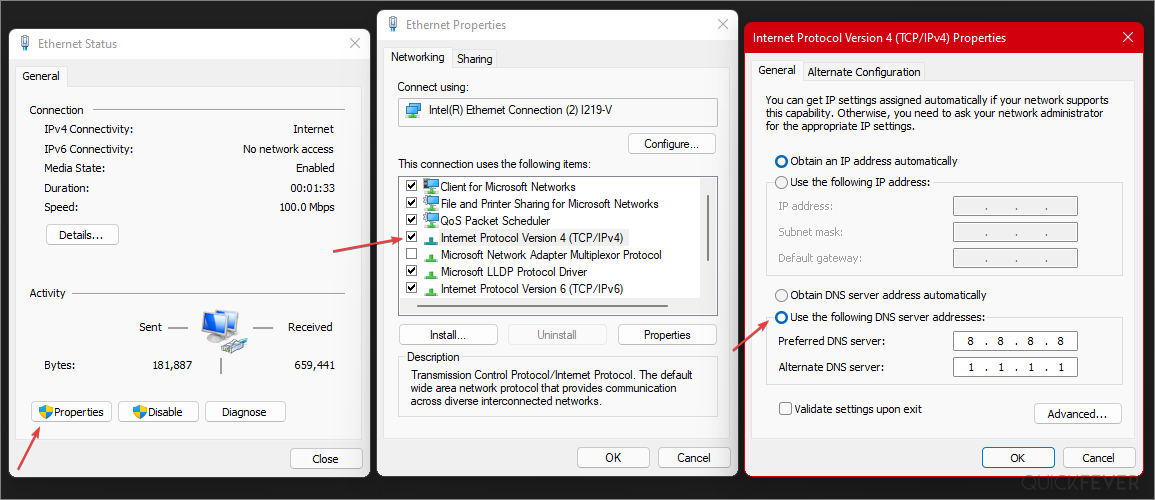
- Select Internet Protocol Version 4 (TCP/IPv4) and click the Properties button.
- Choose Use the following DNS server addresses and enter your chosen IPs (e.g.
8.8.8.8and8.8.4.4for Google, or1.1.1.1and1.0.0.1for Cloudflare). Click OK.
How to Set Up Private DNS on Android (Block Ads & Encrypt Queries)
Android includes a built-in Private DNS feature using DNS-over-TLS (DoT). This encrypts all DNS lookups across both Wi-Fi networks and mobile cellular data. If you use AdGuard’s Private DNS hostname, it automatically blocks banner ads, pop-ups, and trackers across your entire device without installing third-party apps:
- Open Settings on your Android phone and navigate to Network & internet (or Connections > More connection settings on Samsung devices).
- Tap on Private DNS.
- Select Private DNS provider hostname.
- Enter your desired hostname (do not include
https://): - For Ad & Tracker Blocking:
dns.adguard-dns.com - For Cloudflare Speed:
one.one.one.one - For Quad9 Malware Protection:
dns.quad9.net - For Google DNS:
dns.google - Tap Save. Your entire phone now queries DNS over an encrypted TLS connection!
Pro Tip: Flush Your DNS Cache After Changing Servers
Windows stores previously resolved domain names in an internal cache. If you change your DNS servers, old records might still be used until the cache expires. To force your PC to immediately resolve using your new DNS server, open Command Prompt and execute:
ipconfig /flushdnsYou should see: “Successfully flushed the DNS Resolver Cache.”
Summary: Which DNS Server Should You Pick?
- Cloudflare (1.1.1.1): The best overall pick for raw speed, lowest ping, and strict privacy. Cloudflare also offers the 1.1.1.1 with WARP app for Windows, macOS, Android, and iOS as a lightweight alternative to full VPNs (check out our roundup of free VPNs for Windows if you need complete location spoofing).
- Google (8.8.8.8): The most battle-tested, globally distributed resolver. Ideal if you frequently use Google Workspace, YouTube, and cloud services, with near-zero downtime.
- Quad9 (9.9.9.9): The #1 choice for security-conscious users. Operated by a Swiss non-profit, Quad9 automatically blocks known malicious domains, botnets, and ransomware before they reach your browser.
- AdGuard DNS (94.140.14.14): Perfect for households that want to eliminate annoying mobile advertisements, tracking beacons, and pop-ups without configuring browser extensions.
To benchmark and verify which resolver delivers the lowest latency for your specific internet connection and geographic location, you can download Steve Gibson’s free DNS Benchmark tool (for Windows) or test response times at DNSPerf.com.