


TeamViewer is easily one of the most recognized remote desktop tools in the world, but it has become increasingly frustrating for everyday users. Constant commercial use suspicion popups, strict connection time limits, and expensive licensing push many people to look elsewhere. Luckily, you have plenty of capable remote access tools to mirror your PC screen, transfer files, or control unattended computers from your phone, laptop, or tablet.
Whether you want a simple browser-based screen mirror for personal troubleshooting, an ultra-low latency tool for remote gaming and video editing, or a completely open-source solution you can self-host, this guide covers the best TeamViewer alternatives available today. All software listed here supports Windows 10 and Windows 11, along with cross-platform clients for macOS, Linux, Android, and iOS.
The best TeamViewer alternatives to mirror your PC screen
Quick comparison of TeamViewer alternatives
| Software | License / Pricing | Self-Hostable | Performance | Best For |
|---|---|---|---|---|
| RustDesk | Free & Open Source | Yes (Docker / Server) | Low latency (P2P / Custom relay) | Best open-source TeamViewer replacement |
| AnyDesk | Free personal / Paid commercial | No | High (DeskRT codec, 60 FPS) | Best lightweight everyday remote support |
| Parsec | Free personal / Paid Teams | No | Ultra-low latency (60+ FPS hardware accelerated) | Best for remote gaming and video editing |
| Chrome Remote Desktop | 100% Free | No | Moderate | Best simple browser-based personal remote access |
| Sunshine & Moonlight | Free & Open Source | Yes (Local / Tailscale) | Ultra-low latency (Zero lag NVENC/VAAPI) | Best high-framerate PC-to-screen streaming |
| Remote Utilities | Free for 10 endpoints / Paid | Optional self-hosted server | Standard | Best advanced Windows IT administration |
| Splashtop | Paid (Free trial available) | No | High (Smooth HD video) | Best commercial alternative for small teams |
| RemotePC | Paid (Affordable annual plans) | No | Standard | Best budget multi-device cloud remote access |
1. RustDesk
License: Free and Open Source (AGPL v3) | Self-hostable: Yes | Get RustDesk
If you want a true replacement for TeamViewer without intrusive licensing limits or corporate telemetry, RustDesk is the absolute standout. Written in Rust, it is completely open source and gives you full control over your data. Out of the box, you can use RustDesk’s public rendezvous servers just like TeamViewer: enter the remote ID and one-time password to connect instantly.
For power users and small offices, RustDesk allows you to self-host your own relay and signaling server using Docker or a lightweight VPS. That means your connection data never touches third-party infrastructure. It features end-to-end encryption, built-in file transfer, TCP tunneling, remote terminal access, and clients across Windows, macOS, Linux, Android, and iOS.
- Pros: Completely open source with zero license nagging, optional self-hosting for complete privacy, cross-platform support, built-in file transfer and chat.
- Cons: Public relay servers can occasionally experience slowdowns during peak hours; self-hosting requires basic server setup knowledge.
2. AnyDesk
License: Free personal use / Paid commercial tiers | Self-hostable: No | Get AnyDesk
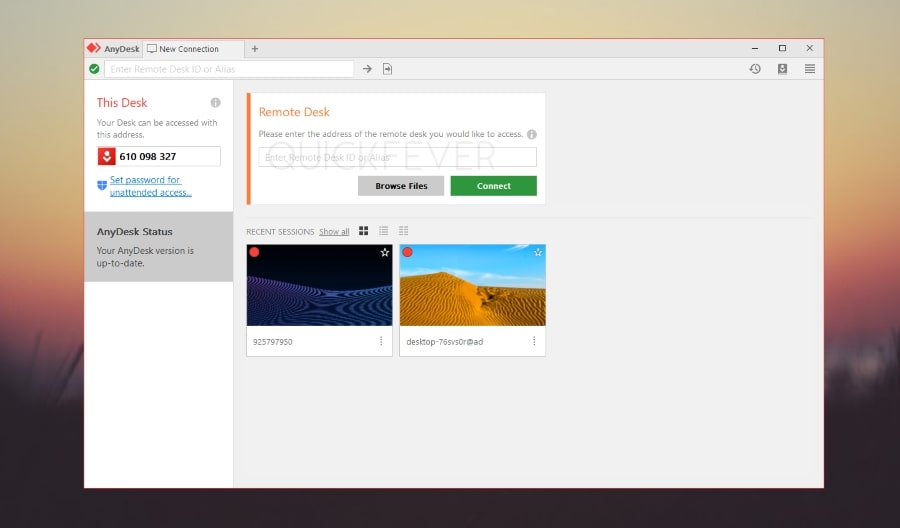
AnyDesk is a longtime favorite for fast, hassle-free remote support. The standalone executable is tiny (under 5 MB), allowing you to launch it immediately without going through a full installation. It uses the proprietary DeskRT video codec, which compresses image data efficiently to provide smooth 60 FPS screen rendering even on modest broadband connections.
Connecting to a remote machine is straightforward: share your nine-digit AnyDesk ID, and the host will see an acceptance prompt. You can also configure unattended access with a custom password so you can access your home or office PC while traveling. AnyDesk includes file transfer, session recording, clipboard sharing, and remote audio playback. Keep in mind that AnyDesk has tightened commercial use detection on its free tier, so for extensive business use, a paid license is required.
- Pros: Extremely lightweight executable, responsive 60 FPS screen refresh rate, unattended access support, simple connection workflow.
- Cons: Free tier displays timeout prompts if it suspects commercial activity, advanced administrative management locked behind paid plans.
3. Parsec
License: Free personal use / Paid Teams | Self-hostable: No | Get Parsec
Originally designed for cloud gaming and remote cooperative play, Parsec has evolved into one of the most powerful low-latency desktop streaming tools available. If you have ever tried editing video, playing games, or doing 3D rendering over TeamViewer, you know the frustration of choppy framerates and delayed mouse movements. Parsec solves that completely.
Parsec utilizes hardware-accelerated H.264 and HEVC video encoding directly through your graphics card (NVIDIA, AMD, or Intel). The result is silky smooth 60 FPS (or higher) streaming with input latency measured in single-digit milliseconds. It supports multi-monitor switching, precise game controller passthrough, and fluid dual-screen desktop sharing. While it lacks traditional IT helpdesk features like remote rebooting in safe mode, it is unbeatable for creative professionals and gamers.
- Pros: Industry-leading low latency and 60+ FPS framerates, hardware-accelerated video encoding, flawless gamepad and mouse tracking, excellent for video editing and gaming.
- Cons: Requires a reasonably modern GPU on the host PC, lacks traditional IT ticketing and background administrative maintenance tools.
4. Chrome Remote Desktop
License: 100% Free | Self-hostable: No | Get Chrome Remote Desktop
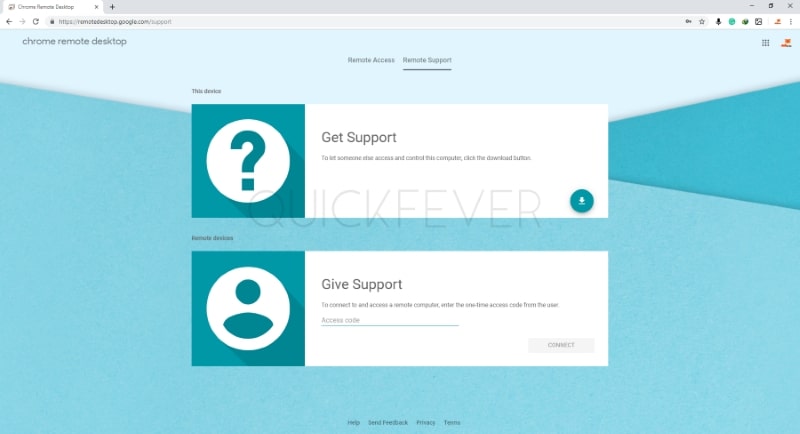
For quick personal remote access without installing complex software, Chrome Remote Desktop is the easiest solution. Operating primarily through Google’s web portal and a lightweight host service, it lets you securely access your computer from any browser, Chromebook, or mobile device linked to your Google account.
The interface is split into two straightforward modes: Remote Support (generate a temporary one-time code to let someone assist you) and Remote Access (set a permanent PIN for unattended access to your own computers). It supports clipboard synchronization, dynamic display scaling, and multi-monitor setups. While it does not include advanced features like voice chat or native file transfer windows, it is completely free with zero ads and zero licensing nags.
- Pros: Completely free with no commercial restrictions, accessible from any browser tab, reliable PIN-based unattended access, backed by Google security infrastructure.
- Cons: Requires a Google account, lacks native two-way file browser, no built-in audio chat, not suited for enterprise management.
5. Sunshine & Moonlight
License: Free and Open Source | Self-hostable: Yes | Get Sunshine Host
When NVIDIA discontinued its proprietary GameStream feature, the open-source community created Sunshine as an independent host, paired with the legendary Moonlight client. Together, Sunshine and Moonlight offer the lowest-latency desktop mirroring solution available, capable of streaming 4K HDR at 120 FPS across local networks or the internet.
Sunshine runs as a lightweight background service on your PC, capturing the desktop via NVENC, AMD AMF, or Intel QuickSync hardware encoders. You can connect from Android TV, iPhones, iPads, MacBooks, or secondary PCs using the Moonlight app. To see how to configure Sunshine with virtual display drivers and controller mapping, explore our complete walkthrough on how to stream PC games to Android TV.
- Pros: Unmatched video quality with support for up to 4K 120 FPS HDR, zero licensing fees, open source, works across Intel, AMD, and NVIDIA GPUs.
- Cons: Setup requires basic port forwarding or a virtual private network (like Tailscale) for remote internet access outside home Wi-Fi.
6. Remote Utilities
License: Free for up to 10 endpoints / Commercial tiers | Self-hostable: Yes (Self-hosted server package) | Get Remote Utilities
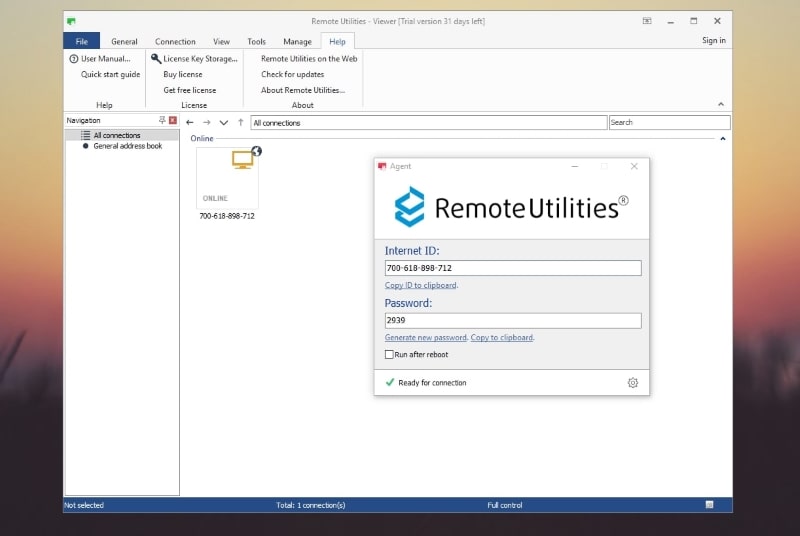
Remote Utilities is built specifically for Windows power users and IT administrators who need granular control over remote systems. The software is split into two packages: the Viewer (installed on the computer you control from) and the Host (installed on the target computer). Both portable and full installer builds are available.
What makes Remote Utilities special is its generous free license: personal and business users can manage up to 10 endpoints completely free of charge. You get full remote desktop viewing, a dedicated two-way file transfer window, remote task manager, terminal command prompt access, and registry editing tools without initiating a visible screen session.
- Pros: Generous free license covers up to 10 computers for personal or commercial use, granular administrative tools (terminal, task manager, registry), optional self-hosted relay server.
- Cons: Interface is feature-dense and can overwhelm casual users, primary focus is on Windows hosts.
7. Splashtop
License: Paid (Free trial available) | Self-hostable: No | Get Splashtop
Splashtop is one of the most reliable commercial remote desktop solutions for individuals, small businesses, and remote teams. Unlike TeamViewer’s steep subscription costs, Splashtop offers affordable tiered plans that provide high-performance audio and video streaming with smooth frame rates.
Splashtop separates its setup into the Splashtop Streamer (installed on the host PC) and the Splashtop Business app (installed on your client device). It features 256-bit AES encryption, multi-to-multi monitor support, remote print capabilities, session recording, and stylus/drawing tablet passthrough, making it particularly appealing for creative professionals working from home.
- Pros: High-definition streaming with responsive audio and video, significantly cheaper than TeamViewer, multi-monitor display options, excellent tablet stylus support.
- Cons: No permanent free tier for remote internet access (free tier is limited to local network connections only), requires separate host streamer installation.
8. RemotePC
License: Paid (Affordable introductory pricing) | Self-hostable: No | Get RemotePC
RemotePC is a polished cloud-based remote access service tailored for home offices and small business fleets. It allows you to connect to Windows, macOS, and Linux computers from anywhere using desktop apps, mobile devices, or a web browser tab.
Features include multi-monitor support, drag-and-drop file transfer, whiteboard annotation tools, remote sound playback, and session recording. RemotePC frequently offers introductory plans that cost a fraction of TeamViewer or LogMeIn, making it a sensible choice if you need official technical support and cloud convenience without corporate enterprise overhead.
- Pros: Straightforward web and app access, multi-monitor switching, drag-and-drop file transfers, budget-friendly entry plans.
- Cons: No permanent free plan (trial only), renewal prices increase after introductory discount periods.
Discontinued and legacy tools to avoid
When searching for TeamViewer alternatives, older tech articles often mention software that has been shut down or is no longer safe to use:
- Join.me: Officially discontinued and sunset by parent company GoTo. The standalone product is no longer sold, and website links redirect to GoTo Meeting.
- Ammyy Admin: While popular in the early 2010s, Ammyy Admin has suffered from severe security compromises and has been widely flagged by modern web browsers and antivirus suites. We advise avoiding it in favor of RustDesk or AnyDesk.
- LogMeIn Pro: While technically still operating under GoTo, LogMeIn Pro has shifted entirely to expensive enterprise pricing ($349+ annually per computer), making it impractical for personal or small-scale users.
Which remote desktop tool should you pick?
TeamViewer is a capable tool, but the constant commercial use warnings make it difficult to recommend for everyday personal setups. If you want a setup that just works without unexpected disconnects, here is how to choose:
- For most users, RustDesk is the modern champion. It gives you the familiar ID-based connection interface of TeamViewer, but it is 100% open source, respects your privacy, and never tries to upsell you.
- If you need ultra-smooth framerates for video editing or gaming, Parsec or Sunshine & Moonlight deliver responsiveness that traditional remote access tools simply cannot match.
- If you only need to connect to your home PC occasionally to grab a file or check a download, Chrome Remote Desktop offers a zero-cost, no-fuss solution inside your browser.
Which remote access tool do you use to control your PC remotely? Let us know your favorite setup in the comments below.






Excellent article! I did not know “Remote utilities”. I have used AnyDesk and Chrome Remote Desktop, but I was not satisfied. My best experience has been with SupRemo.
Best regards!
Thanks
Hello, Neat post. There’s a problem along with your website in web explorer, could test this? IE nonetheless is the marketplace chief and a large component of people will omit your excellent writing due to this problem.|